
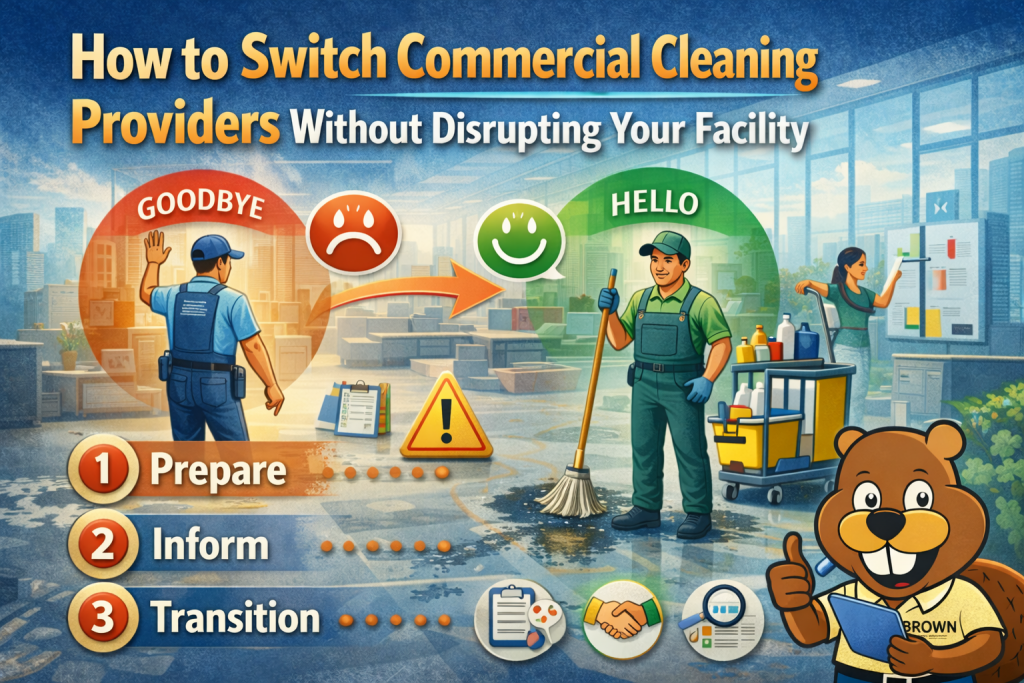
Most facilities don’t avoid switching cleaning providers because they’re satisfied.
They avoid it because they’re afraid of what happens in between.
Missed cleans. Confused staff. Finger-pointing. A messy handoff where nobody is accountable and everything suddenly becomes your problem. For many operations and property managers, the fear of disruption outweighs the frustration of poor service.
That fear is understandable—but it’s also usually misplaced.
Switching commercial cleaning providers doesn’t cause disruption.
Switching without a system does.
This article exists to walk through what actually causes chaos during a switch, how to avoid it, and how facilities transition successfully without breaking routines or creating new problems.
Why Switching Feels Risky (Even When Cleaning Is Failing)
When cleaning quality is poor, it’s rarely catastrophic in one moment. It degrades slowly.
- Details get missed
- Complaints increase
- Standards slip
- Oversight increases
Over time, cleaning becomes something you manage instead of something that just happens.
The irony is that this constant low-level friction becomes familiar. Even bad systems feel safer than unknown ones.
Facilities worry:
- “What if the new provider is worse?”
- “What if onboarding is messy?”
- “What if we lose coverage during the transition?”
Those risks are real—but only when the transition is handled casually.
The Real Causes of Disruption During a Switch
Facilities that experience chaos during a provider change usually fall into one of these traps:
1. No Defined End State
They fire the old provider before defining what “good” actually looks like.
Without a clear scope of work, the new provider is forced to guess—and guessing leads to gaps.
2. Cold Hand-Offs
Service stops on Friday. New provider starts Monday. No overlap. No validation. No margin for error.
That’s not a transition. That’s a gamble.
3. Verbal Expectations
Cleaning expectations live in conversations instead of documents. When staff changes (and it always does), those expectations disappear.
4. Rushed Decisions
Urgency replaces planning. The provider is chosen because they’re available, not because they’re prepared.
None of these problems are caused by switching. They’re caused by poor transition design.
What a Controlled Cleaning Transition Actually Looks Like
A successful switch follows a predictable structure. Not complicated—just intentional.
Step 1: Document Reality (Not Perfection)
You don’t need a perfect audit. You need honesty.
- What areas cause complaints?
- What tasks get missed?
- What frequencies actually matter?
- What does “acceptable” mean for your facility?
This becomes the baseline—not the wish list.
Step 2: Define the Scope Before the Start Date
The new provider should enter with:
- Written scope of work
- Defined frequencies
- Included and excluded areas
- Clear responsibility boundaries
If the scope isn’t clear before service begins, the problems just restart with new faces.
Step 3: Plan Overlap or Validation
The cleanest transitions include:
- A walkthrough before Day 1
- Supervisor presence during the first services
- Early inspections to catch issues before they escalate
This is where stability is created.
Why the Best Time to Switch Is Before It Becomes an Emergency
Facilities that switch calmly usually do it while things are still manageable.
Facilities that wait until cleaning becomes unbearable often create urgency-driven transitions—exactly when mistakes are most likely.
Switching early:
- Preserves leverage
- Allows planning
- Reduces internal pressure
- Produces better outcomes
The longer issues are tolerated, the harder it becomes to change without stress.
What Facilities Get Wrong About “Giving It One More Chance”
Many providers promise improvement when issues are raised.
Sometimes that works—briefly.
But if problems are systemic (turnover, no inspections, no documentation), effort alone won’t fix them. The cycle repeats because nothing structural changes.
Facilities that switch successfully recognize when the issue isn’t motivation—it’s design.
What a Good Provider Does During a Transition
A capable commercial cleaning provider:
- Asks detailed questions upfront
- Pushes for documentation
- Explains how issues are caught early
- Plans the first 30 days intentionally
- Owns outcomes instead of blaming the previous vendor
If a provider treats onboarding casually, they’ll treat ongoing service the same way.
The Goal of Switching Isn’t Improvement—It’s Disappearance
The best cleaning transition is the one that quickly fades into the background.
When done right:
- Complaints drop
- Oversight disappears
- Staff stops talking about cleaning
- The facility feels stable again
That’s not luck. It’s structure.
Service Page Bridge
If you’re considering a switch and want controlled onboarding, defined scopes, and accountability from day one, start with the service that fits your facility:
Each page explains how transitions are structured so cleaning changes don’t disrupt operations.