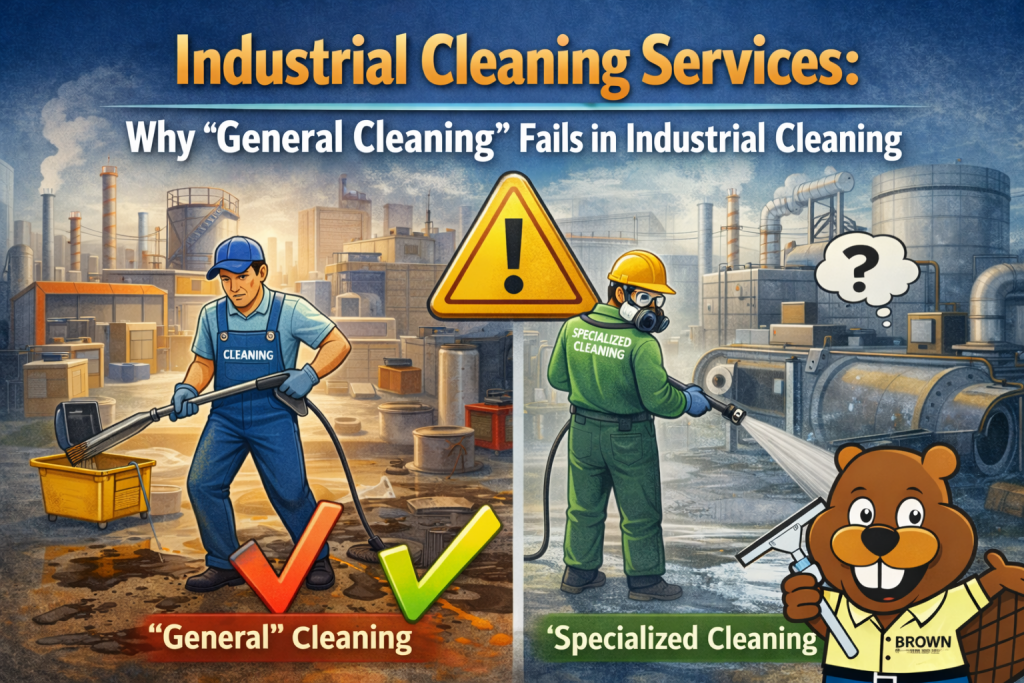
Industrial Facilities Don’t Fail Cleanliness — They Fail Systems
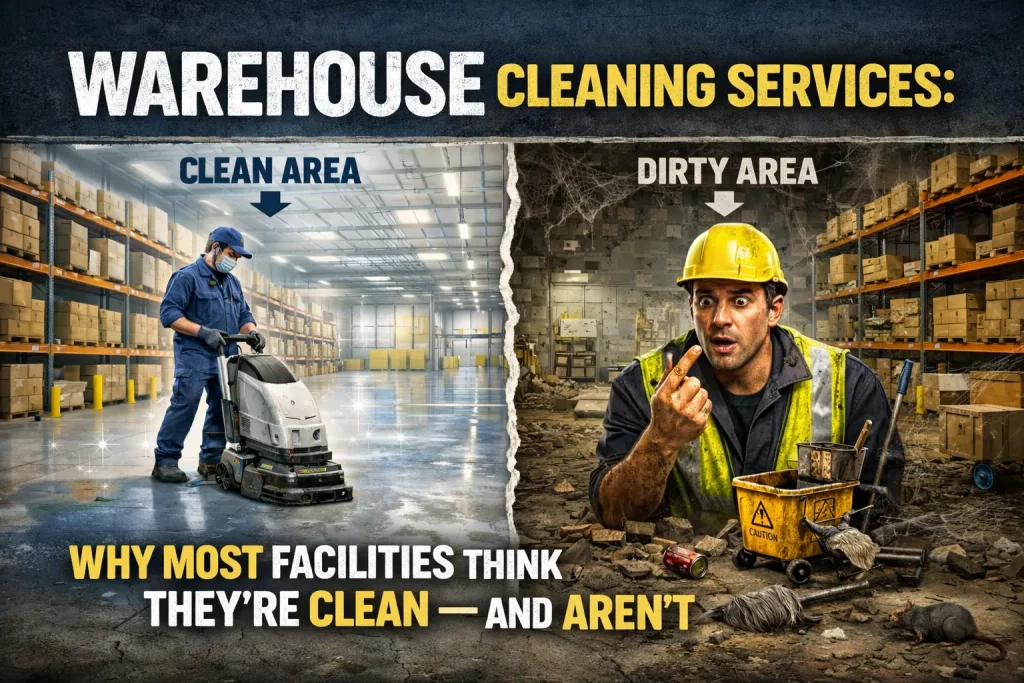
Industrial facilities rarely look dirty at first glance.
That’s why problems get missed.
Industrial cleaning failures don’t start with trash overflow or dirty restrooms. They start with:
- Residue buildup
- Missed high-risk zones
- Improper cleaning methods
- Inconsistent execution
- No documentation
Industrial cleaning is not about appearance. It’s about control.
Why Industrial Cleaning Is a Different Category Entirely
Industrial environments involve:
- Machinery
- Production residue
- Oils and lubricants
- Safety-critical walkways
- Regulatory exposure
- Equipment sensitivity
Applying office-style janitorial cleaning to industrial spaces is a category error.
The Most Common Industrial Cleaning Mistake
The biggest mistake industrial facilities make is outsourcing cleaning without redefining expectations.
They assume:
- Cleaners know what not to touch
- Cleaners understand safety zones
- Cleaners will adapt automatically
They won’t — unless the system is designed for it.
Residue Is the Silent Threat
Industrial residue:
- Builds slowly
- Attracts more contamination
- Degrades equipment
- Creates slip hazards
- Triggers compliance issues
Surface-level cleaning hides residue instead of removing it.
Safety and Cleaning Are Interconnected
In industrial environments, cleaning directly affects:
- Traction
- Visibility
- Equipment access
- Emergency response paths
When cleaning is inconsistent, safety metrics follow.
Why Industrial Facilities Outgrow Janitorial Providers
Most janitorial providers are built for:
- Predictable environments
- Light soil
- Minimal risk exposure
Industrial facilities eventually outgrow that model.
What they need instead is:
- Process-driven cleaning
- Defined boundaries
- Training discipline
- Inspection systems
- Accountability
The Cost of Getting Industrial Cleaning Wrong
Poor industrial cleaning leads to:
- Equipment downtime
- Safety incidents
- OSHA attention
- Management intervention
- Vendor churn
These costs dwarf cleaning invoices.
What Proper Industrial Cleaning Looks Like
Professional industrial cleaning includes:
- Facility-specific scopes of work
- Risk-aware cleaning methods
- Defined exclusions and protections
- Scheduled deep cleaning
- Supervisor oversight
- Documentation
This is how industrial facilities maintain control without micromanagement.
Who Industrial Cleaning Like This Is Built For
This model fits facilities that:
- Operate daily or continuously
- Prioritize safety and uptime
- Require predictability
- Want accountability without overhead
Who It’s Not For
It’s not for:
- One-time deep cleans only
- Facilities avoiding documentation
- Operations looking for the cheapest labor
The Industrial Cleaning Decision That Matters Most
The real decision isn’t who cleans.
It’s whether cleaning is managed or assumed.
Facilities that manage cleaning systems outperform those that hope for results.
Service-Page Bridge
If your industrial facility requires consistent, risk-aware cleaning — not general janitorial work — our Industrial Cleaning Services and Warehouse Cleaning Services pages explain how we structure scopes of work, inspections, and accountability for active production environments.
Review the service that matches your facility type and request a walkthrough when you’re ready.
FAQ BLOCK — INDUSTRIAL CLEANING
Industrial Cleaning Services – Frequently Asked Questions
What is considered industrial cleaning?
Industrial cleaning involves cleaning processes designed for manufacturing plants, production facilities, and industrial environments. It addresses residue, oils, dust, and safety-critical areas that standard janitorial cleaning is not equipped to handle.
How is industrial cleaning different from commercial cleaning?
Commercial cleaning focuses on offices and general business spaces. Industrial cleaning requires risk-aware methods, defined exclusions, equipment sensitivity, and stricter process control due to machinery, production residue, and safety exposure.
Why does industrial cleaning require documentation?
Documentation ensures consistency, accountability, and compliance. Industrial facilities rely on written scopes, inspection records, and corrective action logs to maintain standards regardless of staffing changes or production demands.
Can industrial cleaning reduce safety incidents?
Yes. Proper industrial cleaning improves traction, visibility, and debris control, which directly impacts slip hazards, equipment access, and emergency response paths. Cleaning failures often correlate with increased incidents.
How often should industrial facilities be cleaned?
Cleaning frequency depends on production volume, residue type, and facility layout. Many industrial environments require daily cleaning in critical areas and scheduled deep cleaning to control buildup over time.
What happens when industrial cleaning is done incorrectly?
Incorrect cleaning can damage equipment, spread contaminants, create slip hazards, and increase regulatory risk. Using office-style cleaning methods in industrial spaces often causes more harm than good.
Is industrial cleaning regulated?
While specific cleaning schedules are not mandated, industrial facilities must maintain safe working conditions. Poor cleaning practices can contribute to OSHA findings related to hazards, access, and unsafe surfaces.
How do industrial cleaning companies manage risk?
Professional industrial cleaning companies manage risk through defined scopes, training discipline, restricted access rules, supervision, inspections, and documentation. Risk is controlled through systems—not assumptions.
What should an industrial cleaning contract include?
An industrial cleaning contract should clearly define tasks, frequencies, exclusions, safety boundaries, inspection procedures, and escalation protocols. Vague contracts increase risk and reduce accountability.
Why do industrial facilities outgrow standard janitorial providers?
As operations scale, standard janitorial providers often lack the systems and training required for industrial environments. Facilities outgrow them when safety, compliance, and uptime become priorities.
When should an industrial facility reassess its cleaning program?
If residue buildup is persistent, safety metrics decline, or management is frequently intervening, the cleaning program should be reassessed. These are signs the system is no longer adequate.